Biochar for Competence development for the Circular Carbon eConomy

From Garden Waste to Biochar
A Low-Tech Pyrolysis Approach (blinc)
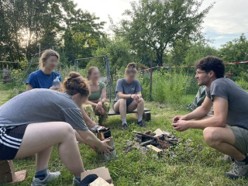
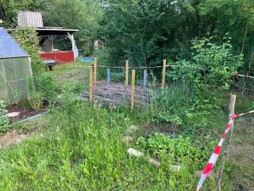
From Garden Waste to Biochar: A Low-Tech Pyrolysis Approach was a pilot project conducted in an allotment garden (Schrebergärten) in Göttingen, Germany.
It engaged adult garden tenants in transforming everyday garden biomass—such as pruning residues, grass, and weeds—into valuable biochar, rather than treating it as waste to be disposed of.
During the hands-on workshop, participants calculated their plot’s annual biomass production and used a low-tech mini-Kon-Tiki kiln to produce biochar.
They then practically applied this knowledge by activating their freshly made biochar with stinging nettle tea and mixing it directly into their garden beds to improve the soil.
The primary goal of the project was to provide a practical understanding of the Circular Carbon Economy and local resource cycles. By engaging in a “Stakeholder and Biochar Network Mapping” exercise, learners extrapolated their biomass data to the entire garden colony.
Ultimately, the project successfully shifted participants’ perspectives on garden waste, demonstrating how biochar can serve as a catalyst for soil enhancement, climate protection, and community-led environmental action.
- Challenge
- Approach
- Activities
- Results
- Impact
The pilot was conducted in a shared allotment garden in Göttingen, where participants regularly manage woody pruning residues from trees and shrubs. While smaller plant materials can be composted relatively easily, woody biomass often accumulates and decomposes only slowly.
The project addressed the question of how this locally available biomass could be transformed into a valuable resource rather than being treated as waste. At the same time, it explored the potential contribution of gardening practices to climate protection, carbon sequestration, and sustainable resource management.
The workshop combined practical biochar production with learning activities on pyrolysis, carbon storage, and Circular Carbon Economy principles.
Using examples from the allotment garden context, participants explored how woody biomass can be converted into stable carbon through low-tech pyrolysis and how biochar can be used to improve soils while contributing to long-term carbon storage.
The learning approach also encouraged participants to consider the wider social and environmental dimensions of biochar use beyond individual gardening practices.
Participants were introduced to the fundamentals of biochar production before producing biochar themselves using a mini-Kon-Tiki kiln.
Activities included:
- Converting locally available pruning residues into biochar
- Observing and discussing the pyrolysis process
- Applying and evaluating the produced biochar
- Exploring the role of biochar in soil improvement and carbon sequestration
- Conducting a stakeholder mapping exercise to identify potential partners and future users
During the stakeholder mapping activity, participants identified neighbouring gardeners, the allotment garden association, and local environmental organisations as potential actors in future biochar initiatives.
Participants gained practical experience in producing and applying biochar while developing a deeper understanding of sustainable biomass management and Circular Carbon Economy concepts.
Key outcomes included:
- Increased awareness of woody biomass as a valuable local resource
- Practical skills in low-tech biochar production
- Improved understanding of soil improvement and carbon sequestration
- Identification of local stakeholders and cooperation opportunities
- Strong interest in sharing experiences within the allotment garden community
The workshop demonstrated that allotment gardens can serve as effective learning environments for exploring sustainability challenges through hands-on experimentation. It also highlighted how local gardening activities can contribute to broader climate protection and circular economy objectives.
Transforming 50 kg of woody biomass into 15 kg of biochar using the Kon-Tiki method and applying it to the plot’s soil creates a measurable, immediate positive footprint across three core areas:
- Climate & Emission Reduction: It isolates carbon that would otherwise rapidly decay during standard composting, leading to a net emission reduction of 35 kg of CO2 equivalents per year.
- Social & Community Value: The project drives community through teamwork by turning routine yard maintenance into a social campfire event, while fostering cooperation over isolation by encouraging neighbors to share tools and knowledge.
- Ecological Co-Benefits: The finished biochar delivers enhanced fertility and water retention by permanently locking moisture and nutrients into the root zone, while creating a stable habitat that triggers boosted microbial life and biodiversity.
The 30-Plot Scaled Scenario
If all 30 garden plots within the association adopt this collective strategy, the combined impact scales up into a powerful local ecosystem project:
- Annual Carbon Sink: The colony actively removes over 1.05 tonnes of CO2 from the atmosphere every year.
- Resource Pooling: A total of 1,500 kg of scattered garden waste is upcycled into 450 kg of high-value, home-grown soil conditioner.
- Club-Wide Transformation: This joint initiative establishes a permanent culture of mutual aid, transforming the entire allotment site into a cohesive, climate-resilient green space.