
The course supports green transition in the construction sector by linking sustainable building materials with practical learning and innovation. It helps participants understand how vocational and adult education can contribute to climate-friendly construction and circular resource use.
Relevant priorities include:
- Environment and fight against climate change
- Innovative learning and teaching practices
- Strengthening employability
- Creating and promoting learning opportunities among all citizens and generations
- Improving the competences of adult educators
- Digitalisation
- Inclusion and Diversity
- Promoting active citizenship
- Common values and civic engagement & participation
The course focuses on biochar-clay composites and their potential role in low-carbon and natural construction. Participants explore how material choices can contribute to carbon storage, resource efficiency and sustainable renovation.
Main topics include:
- Circular Carbon Economy and sustainable construction
- Biochar as a carbon-storing material
- Biochar-clay composites and earthen construction
- Carbon storage in buildings
- Climate-friendly renovation and natural materials
- Clay plaster, earthen boards and earthen bricks
- Hemp fibres, hemp shives and willow-based materials
- Moisture regulation, thermal performance and material behaviour
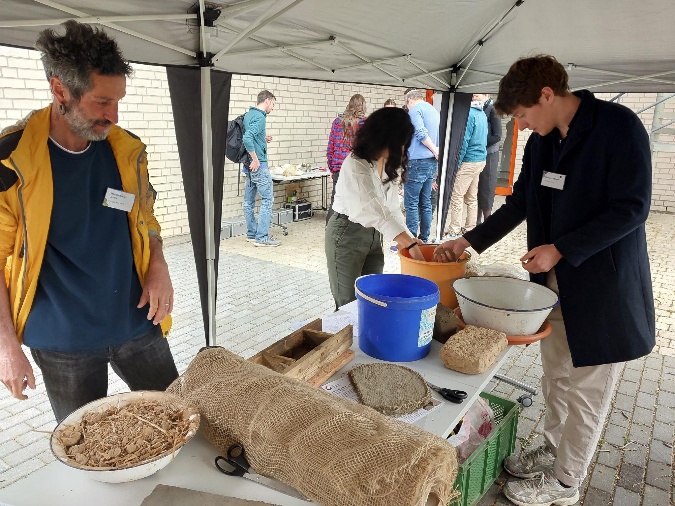
- Hands-on preparation of biochar-clay mixtures
- Demonstration surfaces and practical learning objects
The course is suitable for learners and professionals who want to connect sustainable construction with practical material experimentation and green skills development.
Potential participants include:
- Adult educators and VET teachers
- Construction trainers and vocational educators
- Craftspeople, builders, plasterers and renovation practitioners
- Architects, engineers and planners
- Learners in construction, design, sustainability or environmental education
- Municipal climate managers and local development actors
- NGOs and civic initiatives working on sustainable buildings
- Project developers interested in circular carbon solutions and bio-based materials
After completing the course, participants will understand how biochar can contribute to sustainable construction and how practical material experimentation can be used in education, training and project development.
Participants will be able to:
- explain the basic idea of the Circular Carbon Economy in relation to construction materials;
- describe how biochar can contribute to carbon storage in building-related applications;
- understand the potential and limitations of biochar-clay composites;
- prepare simple biochar-clay mixtures under guidance;
- produce and compare small test samples such as plaster patches, boards or bricks;
- observe and discuss material behaviour, workability, texture and visual properties;
- reflect on how sustainable construction materials can be used in education, renovation or local projects;
- develop a first transfer idea for a course, workshop, demonstration or project in their own context;
- strengthen green skills, collaboration, systems thinking and innovation-oriented learning competences.
From Circular Carbon Economy to Sustainable Construction introduces participants to the potential of biochar as a carbon-storing component in natural and earthen building materials. The course explores how biochar-clay composites can connect climate action, circular resource use, craftsmanship and sustainable renovation.
The methodology combines:
- short theoretical input;
- demonstration-based learning;
- hands-on material experimentation;
- group discussion and peer exchange;
- observation and comparison of material behaviour;
- reflection on transfer into education and construction practice.
Participants learn about Circular Carbon Economy principles, the role of biochar in carbon storage and the potential of earthen construction materials such as clay plaster, dry-construction boards and bricks. They experiment with mixtures of clay, biochar and additional natural materials such as hemp fibres, hemp shives or willow materials.
The course follows a competence-oriented and learner-centred approach. Participants are encouraged to observe, compare, test and discuss. The aim is to make sustainable construction tangible and to show how practical material work can support green skills, innovation and climate-related learning.
The course supports the European Green Deal and Erasmus+ priorities by promoting green skills, climate action and innovative vocational and adult education. Sustainable construction is a shared European challenge, and the building sector offers major opportunities for reducing emissions, storing carbon and developing circular material strategies.
The European dimension is reflected through:
- transferable learning methods for VET, adult education and construction training;
- relevance for different European building and renovation contexts;
- support for green skills and employability in emerging sustainable construction fields;
- exchange between participants from different countries and professional backgrounds;
- comparison of natural building traditions and material practices;
- integration of practical experimentation with European climate and circular economy objectives;
- alignment with Erasmus+ priorities on sustainability, innovation, inclusion and lifelong learning.