
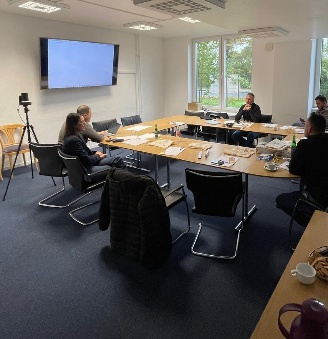

The course supports the development of innovative and sustainability-oriented teaching in agricultural VET. It helps educators move from traditional knowledge transfer towards facilitation, participation and competence-oriented learning.
Relevant priorities include:
- Environment and fight against climate change
- Innovative learning and teaching practices
- Improving the competences of adult educators
- Strengthening employability
- Creating and promoting learning opportunities among all citizens and generations
- Digitalisation
- Inclusion and Diversity
- Promoting active citizenship
- Common values and civic engagement & participation
The course links biochar in agriculture with Design Thinking and learner-centred educational design. Participants work on practical teaching ideas that can later be transferred into vocational training.
Main topics include:
- Biochar in agriculture
- Sustainable agriculture and climate protection
- Circular Carbon Economy
- Design Thinking methodology
- Learner-centred vocational education
- Participatory and collaborative learning
- Innovation in agricultural VET
- Problem-solving approaches in agricultural education
- Development of sustainability-oriented learning concepts
The course is designed for educational professionals who want to make sustainability topics in agriculture more practical, interactive and motivating for learners.
Potential participants include:
- Vocational school teachers in agriculture
- Agricultural trainers and facilitators
- Adult educators working with sustainability or agriculture
- VET course designers and curriculum developers
- In-company trainers in agricultural contexts
- Agricultural advisors involved in training activities
- Educational teams working on climate action, soil, biomass or Circular Carbon Economy topics
After completing the course, participants will understand how Design Thinking can support practical sustainability learning in agricultural VET. They will also develop first educational ideas or prototypes for teaching biochar-related topics.
Participants will be able to:
- explain the role of biochar in sustainable agricultural systems;
- describe basic Circular Carbon Economy principles in an agricultural context;
- understand Design Thinking as a practical facilitation methodology for VET;
- analyse learner needs and educational barriers related to sustainability topics;
- structure participatory learning activities for apprentices;
- develop a first prototype for a learner-centred biochar learning activity;
- strengthen facilitation, communication, creativity and collaborative problem-solving competences;
- reflect on how to transfer the workshop results into their own teaching or training context.
Design Thinking Workshop – Teaching Biochar in Agriculture is a practical teacher-training course for vocational educators working in agricultural education. The course helps participants explore how complex sustainability topics such as biochar, climate protection and Circular Carbon Economy can be taught through participatory and learner-centred methods.
The methodology combines:
- short theoretical input;
- group discussion;
- brainstorming and ideation;
- problem definition;
- Design Thinking exercises;
- prototype development;
- group presentations;
- reflection and transfer planning.
Participants work on the central question: How can biochar in agriculture become more understandable, practical and motivating for apprentices?
Instead of only learning about Design Thinking, participants experience the method themselves. They analyse educational challenges from the perspective of apprentices, develop first learning concepts and create practical prototypes for future learning activities. The course supports a shift from teacher-centred instruction towards facilitation, creativity and collaborative learning design.
The course supports Erasmus+ priorities by promoting green skills, innovative teaching and European cooperation in vocational education. Sustainable agriculture, climate protection and circular resource use are shared challenges across Europe, and agricultural VET providers need practical methods to address these topics with learners.
The European dimension is reflected through:
- transferable methods for agricultural VET and adult education;
- shared European challenges related to climate-friendly agriculture and sustainability learning;
- exchange between teachers, trainers and facilitators from different countries;
- comparison of agricultural education systems and teaching practices;
- co-creation of learning concepts that can be adapted to different national or regional contexts;
- support for active citizenship, inclusion and responsibility for climate action;
- alignment with Erasmus+ priorities on sustainability, innovation and lifelong learning.
The course can be implemented in multicultural and transnational learning settings. It encourages participants to exchange experience, learn from each other and develop biochar-related learning concepts that can be transferred to their own institutions and regions.