Biochar for Competence development for the Circular Carbon eConomy

Biochar in Construction
Building with Carbon-Storing Materials (IFSB)
The IFSB pilot introduced biochar as a sustainable, carbon-storing additive for concrete to help reduce the construction sector’s carbon footprint.
The training was divided into two tracks: a theoretical session for white-collar professionals (such as architects and engineers) and a hands-on workshop for blue-collar masons.
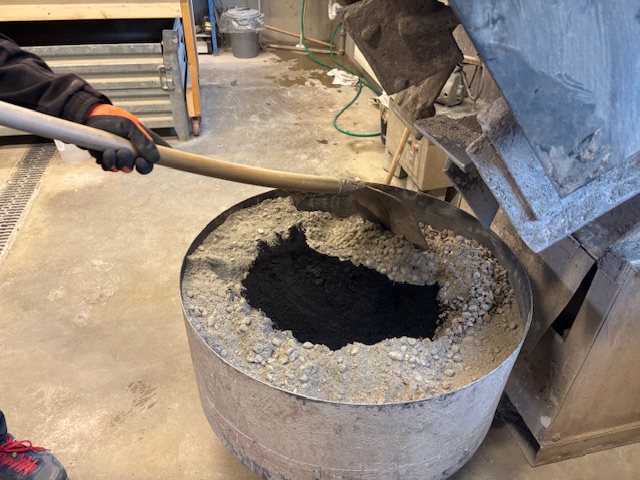
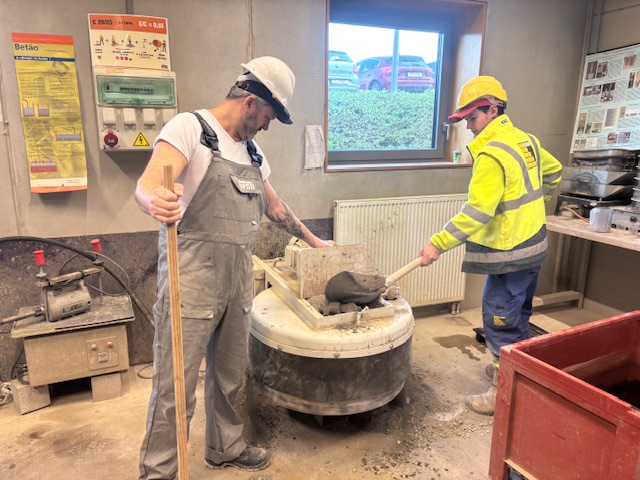
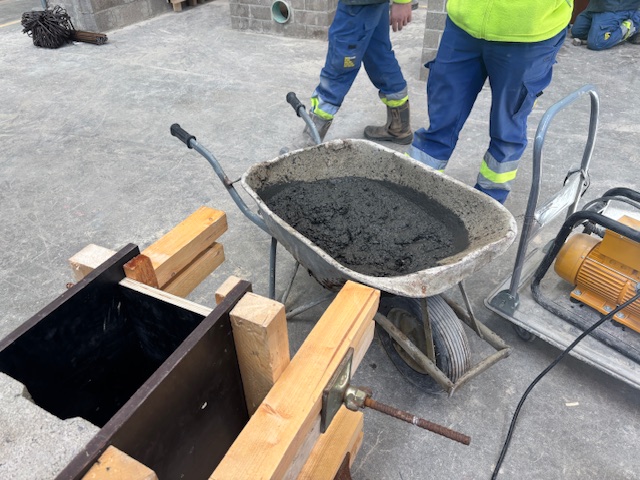
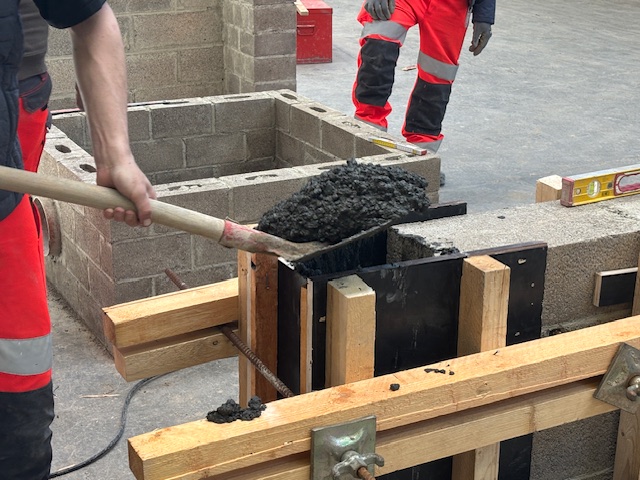
During the practical workshop, the masons mixed biochar into concrete to create physical test structures, including posts and 15 cm cubes. They observed that the biochar made the concrete darker and altered its texture. While the environmental benefits of carbon storage were highly appealing, participants also learned about technical trade-offs, specifically that biochar can slightly reduce the concrete’s compressive strength.
Overall, the pilot successfully demonstrated how to effectively integrate emerging, low-carbon materials into vocational construction training
- Challenge
- Approach
- Activities
- Results
- Impact
The construction sector is facing increasing pressure to reduce carbon emissions and adopt more sustainable materials. Within this context, Biochar was identified as a promising innovation due to its carbon storage potential and its possible contribution to climate change mitigation when integrated into construction materials such as concrete.
The B4C project provided the framework for IFSB to explore how Biochar could be introduced into vocational training and construction practice. The main challenge was to transform an innovative but largely unfamiliar concept into a practical learning experience that would enable construction professionals to understand, test, and evaluate Biochar under real working conditions.
The pilot was designed as a stepwise learning pathway combining theoretical knowledge transfer with practical experimentation.
The first phase focused on awareness raising and introductory training. On 29 January 2026, Biochar was integrated into the Brevet Q course delivered by IFSB. Eighteen participants, including technicians, engineers, and architects, explored:
- Biochar production and properties
- Carbon storage potential
- Applications in sustainable construction
- The role of Biochar in climate change mitigation
Following this introduction, a second training pathway was developed for blue-collar construction professionals, particularly masons. This pathway combined theoretical preparation with hands-on activities to support the transition from knowledge acquisition to practical application.
On 6 March 2026, participants attended a theoretical session covering:
- Environmental benefits of Biochar
- Carbon sequestration potential
- Applications of Biochar in concrete mixtures
On 20 March 2026, participants took part in practical exercises at the IFSB training centre. Activities included:
- Mixing Biochar-based concrete
- Producing structural concrete elements, including posts
- Manufacturing standardized 15 cm concrete cubes for future compression and resistance testing
During the practical sessions, participants evaluated the behaviour of Biochar-concrete mixtures and discussed both technical and environmental aspects. Key observations included:
- Darker colour of the concrete due to Biochar addition
- Differences in texture and workability during mixing
- Strong interest in the carbon storage potential of the material
The training also addressed potential trade-offs, including the possible reduction in compressive strength compared to conventional concrete. These discussions encouraged participants to consider the balance between environmental performance and structural requirements.
The pilot successfully transformed an innovative concept into a practical vocational training experience.
Participants developed competencies in:
- Understanding Biochar properties and applications
- Preparing Biochar-based concrete mixtures
- Assessing environmental and technical performance
Key outcomes included:
- Successful integration of Biochar into vocational construction training
- Demonstration of the feasibility of hands-on experimentation with innovative materials
- Increased awareness of sustainability and carbon storage in construction practice
- Production of concrete posts and standardized test cubes for future resistance testing
The pilot confirmed that innovative construction materials can be effectively introduced through a combination of structured learning and practical experimentation. It also established a foundation for future training activities, further material testing, and the continued development of sustainable construction practices.
One challenge remained the initial acceptance of Biochar as an unfamiliar material. However, as participants gained knowledge and practical experience, interest increased significantly, and Biochar came to be viewed as a potential contribution to the decarbonisation of the construction sector.
This pilot project demonstrates that replacing 5% of cement with biochar transforms concrete from a carbon source into an active carbon sink.
- Unit Impact: A single 15 cm concrete cube reduces net emissions by 224 grams of CO₂ through permanent carbon storage and reduced cement production. This scales to a reduction of 66 kg of CO₂ per cubic meter.
- House Scenario: Implementing this mix in a standard 140 m² single-family home (180 m³ of concrete) integrates 3.15 tons of biochar into the structure. This locks away 9 tons of CO₂ and avoids 3 tons of industrial emissions, netting a total reduction of 12 tons of CO₂.
- Significance: This 12-ton mitigation equals the annual carbon absorption of 950 mature trees or driving 63,000 kilometers in a gasoline car. Additionally, the porous biochar acts as a natural moisture buffer, improving indoor air quality and thermal insulation.