
Entering the Pilots
From Pilots to Practice: Biochar Learning in Action across Europe
The B4C project has moved from concept development into practical testing. Across Europe, partners implemented pilot activities to explore how biochar and the Circular Carbon Economy can be introduced into vocational education, professional training and public awareness.
The pilots showed that biochar can become a practical learning topic for many different groups, including students, teachers, trainers, professionals, municipalities and community actors. Through experiments, workshops, webinars, demonstrations and real-life examples, learners explored how residual biomass can be transformed into valuable carbon-rich materials.
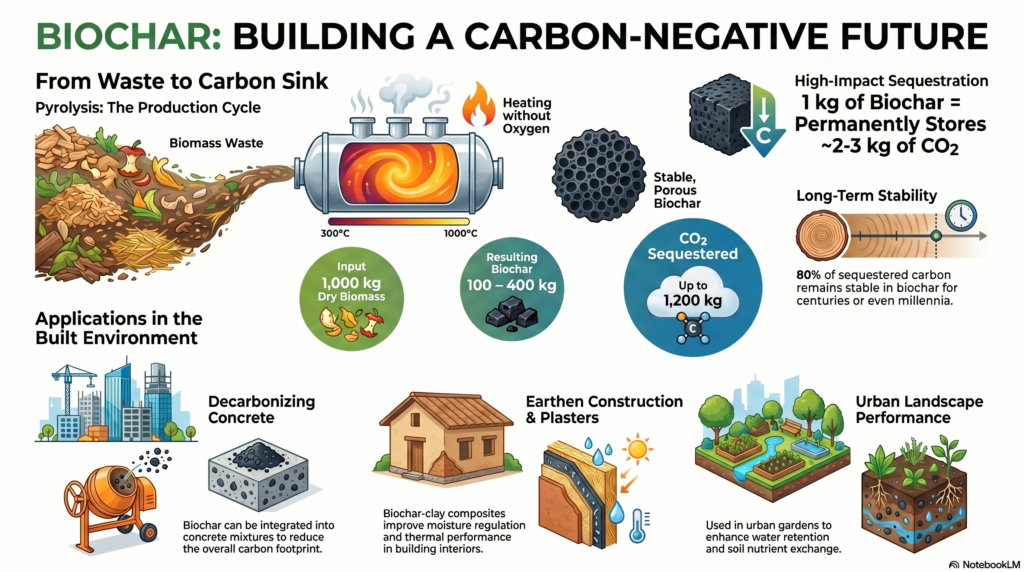
A central aim was to make the Circular Carbon Economy visible and understandable. Biochar was presented as a potential carbon sink, soil improver, construction additive and starting point for sustainability education. In this way, the pilots connected climate protection with concrete examples from agriculture, horticulture, construction, urban gardening and local communities
Pilot activities across sectors
The B4C pilots covered a broad range of topics and learning settings.
In construction, participants explored biochar-based concrete and earthen building materials, produced sample elements and discussed the balance between environmental benefits and technical performance.
In agriculture and horticulture, pilots focused on nutrient cycles, slurry management, soil fertility, ornamental production, urban gardening and landscape applications. Learners investigated how biochar can support water retention, plant growth, soil improvement and sustainable biomass use.
In education and public awareness, partners developed learning materials, toolkits, teacher training activities and awareness resources to make biochar easier to understand and integrate into vocational learning.
Examples included the Biochar Awareness Hub, the Biochar Urban Garden Booster, BiocharVET EDU, Design Thinking workshops, slurry management training at DEULA Nienburg, biochar-based concrete training in Luxembourg, landscape-related training in France, allotment garden activities in Göttingen, and webinars for advisors, growers and local stakeholders.
Learning by doing
A key strength of the pilots was their practical orientation. Instead of presenting biochar only as theory, the activities invited learners to observe, test, compare, discuss and develop their own ideas.
This is especially important for vocational education, where learning becomes meaningful when it is linked to real materials, real sectors and real professional challenges. The pilots used short inputs, guided experiments, demonstrations, site visits, group work and project-based learning.
The activities also showed that different target groups need different approaches. Professionals need technical examples, students need hands-on tasks, and teachers need adaptable materials for their own curricula.
From awareness to implementation
The pilots supported the development of knowledge, skills and attitudes linked to the Circular Carbon Economy. Learners gained a better understanding of biochar, biomass, carbon storage and sustainability, while also developing curiosity, responsibility, openness to innovation and motivation to act.
Overall, the pilot phase shows that biochar can be introduced into education and practice in many ways: as a climate education topic, an experimental material, a soil and water management tool, a construction additive or a starting point for local Circular Carbon Economy projects.
By bringing together training providers, companies, municipalities, researchers, schools and community stakeholders, B4C demonstrates how biochar can connect education, innovation and sustainable regional development.
The pilot phase therefore marks an important step: from learning about biochar to applying it in real educational and professional contexts.