Biochar for Competence development for the Circular Carbon eConomy

Biochar in Slurry (DEULA)
Biochar in Slurry was a pilot project led by DEULA Nienburg that focused on integrating biochar into agricultural nutrient management to address pressing environmental challenges, such as ammonia emissions and nutrient losses in manure systems.
The training targeted agricultural vocational students and apprentices, combining theoretical knowledge with Design Thinking and hands-on experimentation.
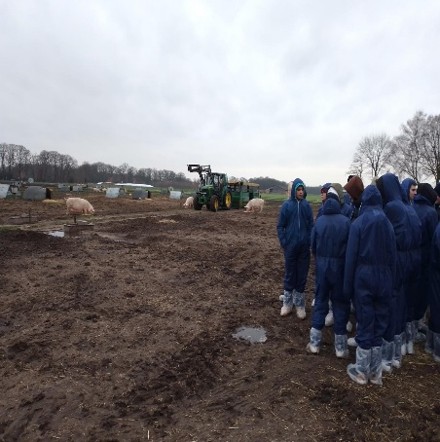
A major highlight of the project was a field trip to a local farm that produces biochar on-site for use in animal bedding, allowing learners to see circular processes in action.
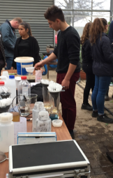
Participants then conducted a practical mini-experiment where they mixed biochar directly into slurry, which allowed them to physically observe its effects, such as odor reduction and nutrient retention.
Ultimately, the pilot transformed manure management from an abstract concept into a tangible resource strategy.
By actively engaging in system analysis and problem-solving, learners developed a much deeper understanding of nutrient cycles and how biochar can be used to make livestock farming more sustainable and climate-friendly.
- Challenge
- Approach
- Activities
- Results
- Impact
Agriculture is facing increasing pressure to reduce emissions, improve nutrient efficiency, and transition towards more sustainable and circular production systems. Within this context, slurry management was identified as a key challenge due to its links to nutrient losses, ammonia emissions, and environmental impacts.
At the same time, innovative approaches such as the Circular Carbon Economy and the use of biochar are gaining relevance but remain largely abstract concepts within vocational education and training. The pilot project at DEULA Nienburg was therefore designed to make these concepts tangible and applicable for vocational learners. The objective was not only to transfer knowledge but also to enable learners to explore agricultural systems, investigate innovative solutions, and develop their own ideas for sustainable farming practices.
The pilot combined sustainability-related content with participatory, practice-oriented, and design-based learning methods.
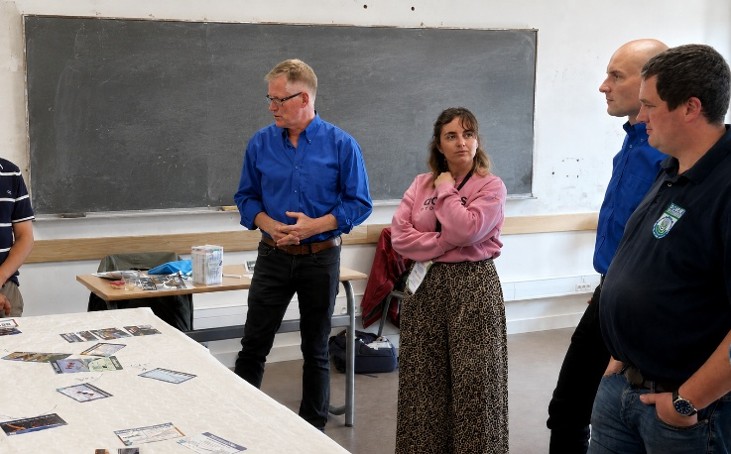
The preparation phase began with a Design Thinking workshop for teachers and trainers. This was an important step in developing the learning pathway and supporting a shift from traditional teaching methods towards a more learner-centred and facilitative approach. Teachers collaboratively designed the learning process and explored how sustainability topics could be integrated into vocational training through active learning methods.
Before addressing practical applications, learners were introduced to the fundamentals of biochar. A short explanatory video and introductory learning activities provided a common understanding of biochar production, properties, and potential applications within agricultural systems.
The pilot was subsequently integrated into the vocational training programme, enabling learners to engage directly with real-world agricultural challenges and sustainability concepts.
The learning process was characterised by collaboration, practical experimentation, and the analysis of real agricultural systems.
Key activities included:
- Introduction to biochar production, properties, and agricultural applications
- Group-based analysis of agricultural systems and slurry management challenges
- Discussion of nutrient management, emissions reduction, and Circular Carbon Economy concepts
- Development of learner-generated solution concepts for sustainable agricultural practices
A central element of the pilot was a farm visit to the Nuttelmann farm, which operates its own pyrolysis plant and produces biochar on-site. During the visit, learners explored how biochar is integrated into a functioning agricultural system, particularly through its use in animal bedding. The visit provided practical insights into the links between animal husbandry, nutrient management, biochar production, and soil improvement.
To complement the field visit, learners conducted a practical mini-experiment in which biochar was mixed with slurry. This activity enabled participants to directly observe potential effects and discuss the role of biochar in nutrient retention and emission reduction.
Building on these experiences, learners developed and presented their own concepts for the use of biochar in agricultural systems. These presentations provided opportunities for critical reflection, peer discussion, and the evaluation of potential benefits and limitations.
Throughout the process, trainers acted primarily as facilitators, supporting group work, encouraging independent thinking, and guiding reflection rather than focusing solely on knowledge transmission.
By the end of the pilot, learners had developed a deeper understanding of agricultural systems and the role that biochar can play within sustainable farming practices.
Key outcomes included:
- Improved understanding of biochar production and applications in agriculture
- Increased awareness of nutrient management, emissions reduction, and Circular Carbon Economy principles
- Practical experience through farm visits and hands-on experimentation
- Enhanced ability to analyse agricultural challenges and evaluate potential solutions
- Development of learner-generated concepts for integrating biochar into farming systems
- Strengthened problem-solving, collaboration, and critical thinking skills
For DEULA Nienburg, the pilot also provided valuable insights into the implementation of innovative teaching approaches within vocational education. The project demonstrated that combining sustainability topics with participatory, design-based, and practice-oriented learning methods can create meaningful learning experiences and support learners in engaging with complex agricultural challenges.
Overall, the pilot showed how vocational education can contribute to the transition towards more sustainable agricultural systems by enabling learners to actively explore, evaluate, and develop innovative solutions for real-world challenges.
Application scenario: Biochar in Livestock Farming and Slurry Management
The project explored how biochar can be integrated into manure and slurry systems to improve nutrient retention and reduce agricultural emissions.
Estimated carbon handprint: A medium-sized livestock farm applying biochar in slurry systems could achieve sequestration and emission reductions of approximately 5–15 tonnes CO₂e annually, depending on herd size and biochar application rates.
Co-benefits:
- Reduced ammonia emissions
- Improved nutrient efficiency
- Reduced odour nuisance
- Improved soil quality after field application
- More circular nutrient cycles