
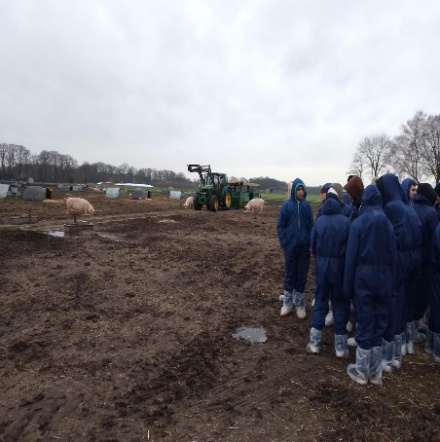

The course supports climate-friendly agriculture by connecting nutrient management, circular resource use and practical vocational learning. It helps participants understand how biochar can become part of more sustainable farming systems.
Relevant priorities include:
- Environment and fight against climate change
- Innovative learning and teaching practices
- Strengthening employability
- Creating and promoting learning opportunities among all citizens and generations
- Improving the competences of adult educators
- Digitalisation
- Inclusion and Diversity
- Promoting active citizenship
- Common values and civic engagement & participation
The course focuses on biochar as a practical tool within slurry and nutrient management. It connects technical agricultural questions with sustainability, climate protection and Circular Carbon Economy thinking.
Main topics include:
- Biochar in slurry and manure systems
- Nutrient cycles in agriculture
- Sustainable nutrient management
- Ammonia emissions and nutrient losses
- Circular Carbon Economy in agricultural systems
- Biochar properties and agricultural functions
- Resource efficiency and emission reduction
- Climate-friendly farming practices
- Farm system analysis
- Practical biochar-slurry experimentation
- Design Thinking and solution development
The course is suitable for participants who want to connect agricultural practice, sustainability and practical learning. It can be adapted to VET, adult education, continuing professional development and agricultural advisory contexts.
Potential participants include:
- VET teachers and trainers in agriculture
- Agricultural apprentices and VET learners
- Adult learners and professionals in agriculture
- Farmers and livestock managers
- Agricultural advisors and sustainability consultants
- Trainers working in nutrient management, soil or livestock-related topics
- Environmental educators and adult education providers
- Municipal or regional actors interested in circular agriculture
- NGOs or initiatives working on soil, water, nutrient cycles or climate-friendly farming
After completing the course, participants will understand how biochar can be explored as part of nutrient management and manure systems. They will also be able to develop first ideas for practical or educational implementation.
Participants will be able to:
- explain the role of biochar in slurry, manure and nutrient management systems;
- describe key challenges such as nutrient losses, ammonia emissions and inefficient resource use;
- understand links between nutrient cycles, Circular Carbon Economy and climate-friendly farming;
- analyse farm systems and identify possible intervention points for biochar applications;
- participate in a practical biochar-slurry experiment and document observations;
- reflect on possible benefits, limitations and implementation conditions;
- apply Design Thinking tools to develop a practical solution idea;
- create a first concept or action plan for a biochar-related nutrient management activity;
- connect the course content to VET, adult education, farm practice or advisory contexts;
- strengthen green skills, systems thinking, collaboration and innovation-oriented competences.
Biochar in Slurry introduces participants to the role of biochar in nutrient management and manure systems. The course addresses current agricultural challenges such as nutrient losses, ammonia emissions, inefficient resource use and the need for more climate-friendly farming systems.
The methodology combines:
- short theoretical input;
- collaborative farm-system analysis;
- practical biochar-slurry experimentation;
- case-based discussion;
- Design Thinking activities;
- group reflection and presentation;
- optional competence reflection.
Participants explore nutrient cycles, slurry management challenges and Circular Carbon Economy principles. They then analyse practical farm systems and test how biochar may influence slurry-related processes. The practical phase is complemented by group-based solution development, where participants design first ideas for using biochar in nutrient management.
The course follows a competence-oriented and learner-centred approach. Participants are encouraged to bring in their own agricultural experience, discuss observations critically and reflect on how biochar could contribute to nutrient efficiency, emission reduction and circular resource use in their own professional or educational context.
The course supports the European Green Deal and Erasmus+ priorities by promoting green skills, sustainable agriculture, climate action and innovative learning in vocational and adult education. Nutrient efficiency, manure management, emission reduction and circular resource use are shared challenges for agricultural regions across Europe.
The European dimension is reflected through:
- transferable learning methods for VET, adult education and agricultural training;
- shared European challenges related to nutrient losses, emissions, soil health and farm resilience;
- support for green skills and employability in sustainable agriculture and circular bioeconomy;
- exchange between participants from different countries, farm systems and professional contexts;
- comparison of agricultural practices, manure systems and biochar application opportunities across regions;
- integration of practical experimentation with European climate, circular economy and sustainability objectives;
- alignment with Erasmus+ priorities on sustainability, innovation, inclusion and lifelong learning.
The course can be implemented in multicultural and transnational learning settings. It encourages participants to compare farming practices, exchange practical experience and develop transferable biochar-based nutrient management ideas for their own regions, organisations or learning environments.