
Biochar in Agriculture
MODULE 1 — Introduction to Biochar in Agriculture
Agriculture is at the centre of several global challenges. Farmers are expected to produce food efficiently while simultaneously reducing environmental impacts, improving soil health, conserving water resources and contributing to climate mitigation.
Biochar has emerged as a promising tool that can help address several of these challenges at the same time. Unlike many agricultural inputs that serve a single purpose, biochar has the potential to support multiple functions within agricultural systems. Depending on how it is produced and applied, biochar may contribute to improved soil structure, enhanced water retention, nutrient management, carbon sequestration and the development of more circular farming systems.
This module explores the role of biochar in agriculture and introduces the most important agricultural application areas. Participants will learn how biochar interacts with soils, composting systems, livestock manure management and crop establishment processes. Through practical examples and real-world applications, the module demonstrates how biochar can become part of sustainable and climate-resilient agricultural production systems.
By the end of this module, learners will be able to identify suitable agricultural applications for biochar, evaluate potential benefits and limitations, and understand how biochar can contribute to the transition towards a Circular Carbon Economy in agriculture.
Before you start
Take a moment to reflect on the following question:
If you had access to biochar today, where would you apply it on a farm?
This could be, for example:
- Soil improvement
- Composting
- Slurry or manure management
- Seed treatment
- Other application
Why apply Biochar?
- Unit 1: CO₂ Sequestration
- Unit 2: CO₂ Balances & Peat Substitution
- Unit 3: Soil Science & Substrate Properties
Did You Know?
Agricultural soils contain more carbon than the atmosphere and all terrestrial vegetation combined. This means that even small improvements in soil carbon storage can contribute significantly to climate change mitigation.
Why Does It Matter?
Climate change is one of the greatest challenges facing modern agriculture. Rising temperatures, increasing drought periods and more frequent extreme weather events are already affecting agricultural production systems around the world. At the same time, agriculture is expected to contribute to climate protection by reducing greenhouse gas emissions and increasing carbon storage.
One promising approach is carbon sequestration. Carbon sequestration refers to the process of capturing and storing carbon for long periods, preventing it from returning to the atmosphere as carbon dioxide (CO₂).
Plants naturally absorb carbon dioxide through photosynthesis and store carbon within their biomass. However, when plant material decomposes or is burned, most of this carbon is released back into the atmosphere. Biochar changes this process. During pyrolysis, biomass is converted into highly stable aromatic carbon structures that decompose very slowly. As a result, a significant proportion of the carbon remains stored for decades or even centuries.
This makes biochar unique among agricultural technologies. It not only supports long-term carbon storage but may also contribute to improved soil functions, nutrient retention and water management. Through biochar, agricultural systems can become active participants in climate mitigation strategies.
Practical Example
A cereal farm produces large quantities of straw after harvest every year. Instead of treating the straw as a waste product, part of the biomass is converted into biochar through pyrolysis. The resulting biochar is applied to agricultural soils where it stores carbon and contributes to long-term soil improvement.
This approach transforms a short-lived biomass resource into a long-term carbon sink.
Key Takeaway
Biochar transforms short-lived biomass carbon into highly stable carbon structures, enabling long-term carbon storage while simultaneously supporting agricultural soil functions.
Reflection
Take a moment to think about your own region.
Which biomass resources are available that could potentially be converted into biochar?
Examples may include:
- Straw
- Crop residues
- Orchard prunings
- Forestry residues
- Green waste
- Animal manure solids
Write down at least three examples and briefly explain why they could be suitable feedstocks.
Did You Know?
Peatlands cover only around 3% of the Earth’s land surface, yet they store approximately one-third of the world’s soil carbon. When peat is extracted for horticultural substrates, this stored carbon is gradually released into the atmosphere.
Why Does It Matter?
For decades, peat has been one of the most important components of growing media used in horticulture, nurseries and plant production systems. Peat provides excellent physical properties, including high water-holding capacity, good aeration and a relatively stable structure.
However, the environmental cost of peat extraction is considerable. Peatlands are among the world’s most important natural carbon sinks. They accumulate carbon over thousands of years under waterlogged conditions. When peat is harvested, these ecosystems are disturbed, and large quantities of stored carbon can be released as greenhouse gases.
As governments and industries seek more sustainable alternatives, biochar has emerged as a promising substitute for peat in many growing media formulations. Depending on its production characteristics and application rate, biochar may improve substrate stability, support water retention and contribute to more sustainable production systems.
Unlike peat, biochar can be produced from renewable biomass resources and may simultaneously contribute to long-term carbon sequestration. This creates an opportunity to reduce the environmental footprint of horticultural production while supporting Circular Carbon Economy principles.
Practical Example
A commercial nursery traditionally uses peat-based substrates for container-grown ornamental plants.
To reduce its environmental impact, the nursery begins replacing a portion of the peat with biochar produced from local forestry residues.
The new substrate mixture provides:
✓ improved sustainability,
✓ reduced dependence on peat extraction,
✓ additional carbon storage,
✓ and comparable plant growth performance.
This demonstrates how biochar can support the transition towards more environmentally responsible growing systems.
Key Takeaway
Biochar can partially replace peat in growing media, helping to reduce pressure on peatland ecosystems while supporting carbon storage and sustainable horticultural production.
Reflection
Consider horticultural or nursery production systems in your region.
- Why do you think peat has remained such a popular growing medium?
- What challenges might growers face when replacing peat with alternative materials such as biochar?
Write down at least three possible opportunities and three possible challenges.
Did You Know?
A single teaspoon of healthy soil can contain more living organisms than there are people on Earth. Soil is not simply a growing medium—it is a complex living ecosystem that supports plant growth, nutrient cycling and water regulation.
Why Does It Matter?
Healthy soils form the foundation of agricultural production. They provide physical support for plant roots, store water and nutrients, host countless microorganisms and regulate many biological and chemical processes that are essential for crop growth.
However, many agricultural soils are facing increasing pressure. Intensive cultivation, erosion, compaction, declining organic matter levels and climate-related stress can reduce soil quality and productivity over time.
Biochar has attracted significant interest because it can influence several important soil functions simultaneously. Due to its porous structure and large internal surface area, biochar may affect physical, chemical and biological soil properties.
Potential effects include improved soil aggregation, enhanced porosity, increased aeration, support for root development and improved habitat conditions for soil microorganisms. These interactions can contribute to greater resilience of agricultural soils, particularly under changing climatic conditions.
It is important to understand that biochar does not function as a miracle solution. Its effectiveness depends on soil type, climate conditions, biochar quality and overall farm management. When integrated appropriately, biochar can strengthen existing soil functions and support long-term soil development.
Understanding Soil Functions
Agricultural soils perform several essential functions:
Physical Functions
Soils provide structural support for plants, regulate water movement and influence root penetration. Soil texture, aggregation and pore space determine how water and air move through the soil profile.
Chemical Functions
Soils store and exchange nutrients needed for plant growth. Soil pH, cation exchange capacity and organic matter content strongly influence nutrient availability.
Biological Functions
Soils host diverse communities of bacteria, fungi, earthworms and other organisms. These organisms contribute to decomposition, nutrient cycling and soil structure formation.
Biochar may interact with all three functions simultaneously.
Practical Example
A farmer manages two neighbouring fields.
The first field contains sandy soil with low organic matter content. During dry periods, crops often suffer from water stress.
The second field contains a loamy soil with better structure and higher biological activity.
After integrating biochar into the sandy soil, improvements in water retention and root development are observed over time. While results vary depending on local conditions, this example illustrates how soil type strongly influences biochar performance.
Key Takeaway
Biochar can support physical, chemical and biological soil functions. However, its effectiveness depends on local conditions and should always be considered as part of a broader soil management strategy.
Reflection
Think about the soils in your own region.
How would you describe them?
- Sandy
- Loamy
- Clay-rich
- Organic soils
Now consider the following questions:
- What are the main soil challenges?
- Is water retention a problem?
- Is compaction common?
- Are nutrient losses significant?
Write down three challenges that local farmers face and discuss whether biochar might help address them.
MODULE 2 — APPLICATION FIELD 1: COMPOST
Composting is one of the most established pathways for recycling organic residues within agricultural systems. Crop residues, green waste, manure and other organic materials are biologically transformed into compost products that can be returned to agricultural soils.
However, composting processes are not automatically sustainable or loss-free. During decomposition, greenhouse gas emissions, nutrient losses and odour formation may occur, particularly when composting conditions are unstable or poorly managed.
The integration of biochar into composting systems creates opportunities to improve and stabilise these biological processes. Due to its porous structure and adsorption capacity, biochar may help retain nutrients, improve aeration and regulate moisture conditions within compost heaps. At the same time, biochar contributes stable carbon to the composting system, thereby linking nutrient recycling with long-term carbon sequestration.
Compost-biochar mixtures therefore combine biological nutrient cycling with durable carbon retention and represent an important element within the Circular Carbon Economy. Instead of treating organic residues merely as waste streams, composting systems enriched with biochar can transform them into valuable long-term resources for soil improvement, carbon management and agricultural resilience.
Did You Know?
Compost heaps can reach temperatures above 60°C during active decomposition.
At these temperatures, billions of microorganisms continuously transform organic materials into stable organic matter. Biochar can provide additional habitat for these microorganisms while helping to stabilise moisture and aeration conditions.
- Unit 1: Learning from Practice: The Japanese Experience
- Unit 2: Why Use Biochar in Composting?
- Unit 3: What Makes a Compost-Biochar System Work?
- Unit 4: How Can Biochar Be Integrated into Composting Systems?
- Unit 5: Experiences from Practice
- Unit 6: Perspectives
This learning unit is based on practical experiences and case-study approaches derived from Japanese composting systems that integrate biochar into organic waste management and agricultural production.
These examples demonstrate how biochar can support the transformation of composting from a disposal-oriented activity into a strategic agricultural process focused on soil improvement, nutrient stabilisation and carbon retention.
The Japanese case studies illustrate how compost-biochar systems can improve process stability, reduce emissions and increase the long-term functionality of compost products within agricultural systems. They also demonstrate how local biomass streams and organic residues can be integrated into circular resource management pathways that connect waste management, agriculture and climate mitigation.
Reflection
Which organic materials are commonly available for composting in your region?
- Crop residues
- Green waste
- Livestock manure
- Food waste
- Other biomass resources
Could these materials become part of a circular resource management system?
The use of biochar within composting systems can contribute to several important improvements in agricultural organic matter management. By interacting with moisture, nutrients and biological activity within the composting process, biochar may help reduce nutrient losses and minimise odours and gaseous emissions that often occur during decomposition.
In addition, biochar can improve aeration and stabilise biological composting processes by supporting more balanced oxygen and moisture conditions within the compost heap.
As the composting process becomes more stable, the quality and consistency of the final compost product may also improve. At the same time, the stable carbon contained in biochar remains within the compost system and can later be transferred into agricultural soils, contributing to long-term carbon sequestration.
Biochar therefore does not replace composting itself. Instead, it functions as a stabilising and enhancing component within the composting process. Through this interaction, composting evolves from a simple organic waste treatment process into a strategic pathway for nutrient cycling, soil development and carbon retention within agricultural systems.
Quick Fact
Biochar does not replace composting.
It improves and stabilises the composting process while supporting nutrient retention and carbon sequestration.
Reflection
Which organic materials are commonly available for composting in your region?
- Crop residues
- Green waste
- Livestock manure
- Food waste
- Other biomass resources
Could these materials become part of a circular resource management system?
Technical Properties
The effectiveness and stability of compost-biochar systems depend on the interaction of several important technical, physical and biological parameters. Composting is a dynamic biological process in which microorganisms continuously transform organic materials under changing environmental conditions. The integration of biochar influences many of these processes and therefore requires careful management of the entire composting system.
One of the most important indicators is temperature development, as temperature provides valuable information about microbial activity and the progress of decomposition. A stable temperature profile often indicates that biological processes are functioning efficiently and that the composting process remains active and balanced.
Moisture content is another critical factor. Microorganisms require sufficient moisture to remain active, yet excessive moisture can reduce oxygen availability and create anaerobic conditions. Maintaining an appropriate moisture level is therefore essential for efficient decomposition and overall compost stability.
Closely linked to moisture is oxygen availability. Composting is primarily an aerobic process, meaning that microorganisms require oxygen to decompose organic matter effectively. Insufficient oxygen can slow decomposition, increase odour formation and promote undesirable anaerobic processes. Biochar can support aeration by improving the structural stability of the compost matrix.
The carbon-to-nitrogen (C:N) ratio also plays a major role in determining decomposition speed and nutrient dynamics. A balanced ratio helps microorganisms efficiently utilise available nutrients and organic materials, thereby supporting stable compost development.
In addition, particle size influences the physical structure of the composting system. The size and distribution of biochar and organic materials affect aeration, moisture distribution, structural stability and the interaction between biochar surfaces and decomposing organic matter.
Another important parameter is the pH value, which influences nutrient availability and the composition of microbial communities. Different microorganisms thrive under different pH conditions, making pH an important factor for biological activity and overall compost quality.
Ultimately, the interaction of temperature, moisture, oxygen availability, carbon-to-nitrogen ratio, particle size and pH determines the stability, efficiency and quality of the composting process. Successful compost-biochar systems therefore require a systems-based approach in which these parameters are continuously monitored and balanced to produce high-quality compost products.
Creating Effective Compost-Biochar Mixtures
The effectiveness of compost-biochar systems depends on a careful balance of materials, environmental conditions and management practices. There is no universal recipe that can be applied to all composting systems because different biomass streams vary considerably in their physical and chemical properties. Successful composting therefore requires adapting mixture strategies to locally available materials and operational objectives.
One of the most important considerations is feedstock selection. Crop residues, livestock manure, green waste and other organic materials each contribute different amounts of carbon, nutrients and moisture to the composting process. Combining these materials appropriately helps create favourable conditions for microbial decomposition and nutrient cycling.
Another important factor is the mixing ratio between the different organic materials and biochar. The proportion of biochar influences aeration, moisture regulation and nutrient retention within the compost heap. At the same time, the structural composition of the mixture affects airflow and physical stability. Materials that are too dense may restrict oxygen movement, while overly coarse materials may slow decomposition processes.
Moisture management is equally important. Compost microorganisms require sufficient water to remain active, but excessive moisture can lead to anaerobic conditions, odour formation and reduced compost quality. Biochar may support moisture regulation by absorbing excess water while maintaining favourable conditions for microbial activity.
Finally, process management plays a key role in determining compost quality. Regular monitoring of temperature, moisture and aeration helps maintain stable biological activity throughout the composting process. As a result, different biomass streams often require different management approaches and mixture strategies to achieve optimal results.
Practical Assignment
Imagine that you have access to crop residues, cattle manure, green waste and biochar. Design a compost mixture that would be suitable for your region and farming conditions.
Consider the following questions:
- Which materials would you combine and why?
- At which stage would you add biochar to the composting process?
- How would you manage moisture levels during decomposition?
- What benefits would you expect from the final compost product?
Prepare a short description of your proposed compost-biochar system and discuss how it could contribute to nutrient management and soil improvement in your region.
Advantages
The potential advantages of compost-biochar systems result from the interaction between biological decomposition processes and the unique physical and chemical properties of biochar. By integrating biochar into composting systems, it is possible to improve both the composting process itself and the quality of the final compost product.
One important benefit is the improvement of compost structure. The porous nature of biochar contributes to a more stable and aerated compost matrix, helping to maintain favourable conditions for microbial activity and decomposition. Improved structure may also reduce compaction within the compost heap and support more efficient oxygen flow.
Biochar may also contribute to reduced odour formation by adsorbing volatile compounds that are released during decomposition. This can improve working conditions and reduce environmental impacts associated with composting operations.
Another significant advantage is nutrient stabilisation. Biochar can retain nutrients within the compost system and reduce nutrient losses during decomposition and storage. As a result, a larger proportion of valuable nutrients remains available for plant growth after compost application.
The highly porous structure of biochar may also create favourable habitat conditions for microorganisms. These protected microenvironments support microbial diversity and activity, which are essential for efficient decomposition and nutrient cycling.
In addition, compost-biochar mixtures often show improved water retention. Biochar can help regulate moisture levels during composting and may continue to support water storage after the compost is applied to agricultural soils.
A further advantage is long-term carbon retention. While many organic compost components gradually decompose after soil application, the stable carbon contained in biochar can remain in agricultural systems for decades or even centuries. Compost-biochar systems therefore combine short-term nutrient cycling with long-term carbon sequestration and contribute to the objectives of the Circular Carbon Economy.
Key Takeaway
Compost-biochar systems combine short-term nutrient cycling with long-term carbon storage.
Limitations
While compost-biochar systems offer numerous potential benefits, several limitations and challenges must be considered before implementation. The effectiveness of these systems depends not only on the properties of biochar itself but also on the quality of the available organic materials, local environmental conditions and management practices.
One important challenge is the variability of feedstocks. Organic materials such as crop residues, manure, green waste and other biomass streams can differ considerably in their nutrient content, moisture levels and decomposition characteristics. These differences influence composting dynamics and make it difficult to apply a single standardised approach to all composting systems.
In addition, significant differences in biochar quality may exist depending on feedstock origin and pyrolysis conditions. Variations in pH value, ash content, adsorption capacity, contaminant levels and carbon stability can affect the performance of biochar within composting systems. As a result, not every biochar product is equally suitable for every agricultural application.
The integration of biochar into composting systems may also involve additional operational costs. These can include the purchase or production of biochar, transportation, handling and monitoring activities. Farmers and compost operators therefore need to evaluate whether the expected benefits justify the additional investment.
Another consideration is the increased need for process management. Compost-biochar systems often require careful monitoring of moisture, aeration, temperature and feedstock composition to achieve optimal results. Poor management can reduce the effectiveness of the system and limit potential benefits.
Furthermore, regulatory considerations may influence implementation. Agricultural applications of compost and biochar may be subject to national regulations, quality standards and certification schemes such as the European Biochar Certificate (EBC). Compliance with these requirements can affect both operational procedures and product marketing.
Finally, successful implementation requires a certain level of technical knowledge and expertise. Understanding composting processes, biochar properties and system interactions is essential for achieving stable and effective outcomes.
For these reasons, biochar should not be viewed as a universal solution that automatically improves every composting system. Instead, it should be considered a process-enhancing component whose success depends on appropriate integration, good management practices and adaptation to local conditions.
Key Takeaway
Biochar can significantly improve composting systems, but its effectiveness depends on feedstock quality, biochar characteristics, management practices and local conditions. Successful compost-biochar systems require knowledge, planning and continuous process optimisation.
Reflection
What challenges might farmers in your region face when implementing compost-biochar systems?
Biochar can be integrated into composting systems at different stages of the composting process, depending on the characteristics of the feedstocks and the operational objectives of the composting system. The timing and method of biochar addition influence how effectively it interacts with moisture, nutrients, microorganisms and aeration dynamics throughout the decomposition process.
One common approach is to add biochar during pile construction, where it is mixed directly with organic materials at the beginning of the composting process. This allows biochar to interact with nutrients and microbial communities from the start and helps establish favourable conditions for decomposition.
Biochar may also be applied between compost layers. In this configuration, biochar acts as a stabilising and adsorbing material that can capture nutrients and volatile compounds while improving structural stability throughout the compost heap.
Another effective strategy involves mixing biochar together with wet feedstocks, such as livestock manure, food waste or other high-moisture organic materials. Because biochar has a porous structure and high adsorption capacity, it can help absorb excess moisture, reduce compaction and improve oxygen availability within the composting system.
In addition, biochar can be introduced during turning and aeration phases. This approach helps distribute biochar more evenly throughout the compost mass and may further improve aeration, moisture regulation and process stability as decomposition progresses.
The most suitable integration strategy depends on several factors, including feedstock composition, moisture conditions, composting scale and operational objectives. Small-scale farm composting systems may require different approaches than industrial or municipal composting operations, while highly wet biomass streams often require different management strategies than dry structural materials.
Successful compost-biochar systems therefore depend not only on the use of biochar itself but also on its careful integration into existing biological and operational composting processes. When properly incorporated, biochar can enhance nutrient retention, improve process stability and contribute to the production of high-quality compost products that support both soil fertility and long-term carbon retention.
Practical experiences from farms, pilot projects and experimental composting systems provide valuable insights into the potential benefits of integrating biochar into composting processes. Although results vary depending on local conditions, feedstocks and management practices, many operators report positive effects on both the composting process itself and the quality of the final compost product.
One of the most frequently observed benefits is reduced odour formation during decomposition. By adsorbing volatile compounds and supporting more stable aerobic conditions, biochar may help minimise unpleasant smells and improve working conditions around composting facilities.
Many practitioners also report more stable temperature development throughout the composting process. Stable temperature profiles often indicate balanced microbial activity and efficient decomposition, suggesting that biochar can contribute to overall process stability.
Another commonly reported effect is improved moisture regulation. The porous structure of biochar can help buffer excess moisture while maintaining favourable conditions for aeration and microbial activity. This may reduce the risk of anaerobic conditions and contribute to more efficient composting.
In addition, biochar may improve the physical structure of compost by creating a more stable and porous compost matrix. Improved structure can support oxygen movement, facilitate handling and contribute to the production of a more homogeneous compost product.
After field application, many users observe more uniform crop development and improved field performance, particularly in situations where soil conditions are challenging. These observations are often linked to improved nutrient availability, enhanced water retention and better soil structure.
Long-term experiences further suggest that compost enriched with biochar may contribute to greater drought resilience by improving the soil’s ability to retain water and support plant growth during periods of limited rainfall.
However, practical experiences also demonstrate that results are highly dependent on local conditions, including climate, feedstock quality, soil characteristics and management practices. Compost-biochar systems should therefore be understood as adaptable management strategies that require adjustment to specific agricultural contexts rather than as standardised solutions that produce identical results everywhere.
Key Takeaway
Experiences from practice show that biochar can improve compost stability, moisture regulation, nutrient management and soil performance. While results vary between regions and farming systems, compost-biochar mixtures have demonstrated considerable potential for supporting resilient and sustainable agricultural production systems.
Connecting to the Regional Bioeconomy
Compost-biochar systems create significant opportunities for the development of regional Circular Carbon Economy strategies and contribute to a more sustainable use of biological resources within agriculture. By integrating biochar into composting processes, organic materials such as crop residues, green waste, livestock manure and other agricultural by-products can be transformed into valuable resources rather than being treated merely as waste streams.
One important opportunity lies in the valorisation of regional biomass resources. Biomass that might otherwise have limited economic value can be incorporated into productive nutrient and carbon cycles, thereby increasing resource efficiency and reducing waste. This approach supports the development of regional bioeconomy systems that make better use of locally available materials.
Compost-biochar systems also contribute to circular nutrient management by retaining nutrients within agricultural production systems for longer periods of time. Instead of losing valuable nutrients through decomposition, leaching or emissions, nutrients can be stabilised within compost products and returned to agricultural soils, supporting long-term soil fertility and productivity.
Another emerging perspective is the integration of compost-biochar systems into carbon farming approaches. Because biochar contains highly stable carbon, compost-biochar mixtures provide an opportunity to transfer durable carbon into agricultural soils, contributing to climate change mitigation while simultaneously improving soil quality.
The development of local composting value chains may further strengthen cooperation between farmers, municipalities, waste management organisations and other bioeconomy actors. Such cooperation can create new economic opportunities while supporting sustainable resource management at the regional level.
In addition, compost-biochar systems align closely with the principles of climate-smart agriculture. By improving nutrient retention, enhancing soil health, supporting water management and contributing to carbon sequestration, these systems help agricultural production become more resilient to climate-related challenges.
Instead of viewing organic residues as materials that must be disposed of, compost-biochar systems transform them into valuable long-term carbon and nutrient resources. This reflects one of the core principles of the Circular Carbon Economy: keeping biological resources, nutrients and carbon within productive systems for as long as possible while reducing losses and environmental impacts.
Final Key Takeaways
Compost-biochar systems demonstrate how agricultural residues can become valuable resources within regional bio economies. By connecting nutrient recycling, carbon retention and sustainable resource management, they support the transition towards more circular, resilient and climate-smart agricultural systems.
Compost-biochar systems transform organic residues from waste streams into valuable resources that support nutrient cycling, soil improvement and long-term carbon retention within the Circular Carbon Economy.
Final Reflection
Imagine your region aims to reduce agricultural waste and improve soil quality. How could compost-biochar systems contribute to these objectives?
Describe one practical implementation pathway.
MODULE 3 — APPLICATION FIELD 2: SOIL CONDITIONER
Healthy soils are the foundation of agricultural production. They provide physical support for plant growth, regulate water and nutrient cycles, host diverse biological communities and contribute to long-term agricultural productivity.
While the previous learning unit focused on compost as a biological transformation process and a pathway for nutrient stabilisation, this unit shifts the perspective toward the soil itself as the central production system in agriculture.
Soils are not static growing media. They are dynamic living systems that continuously change through cultivation practices, climate conditions, organic matter turnover and biological activity. Increasing drought stress, soil compaction, erosion and declining soil organic matter place growing pressure on agricultural systems in many regions.
Within the Circular Carbon Economy, soils are not only production systems but also long-term carbon reservoirs. Biochar therefore becomes relevant not only because it may improve soil functions but because it contributes to long-term carbon retention within agricultural landscapes.
Learning Outcomes
After completing this learning unit, learners will be able to explain the role of biochar as a soil conditioner, identify factors influencing biochar performance in different soil systems, evaluate the advantages and limitations of biochar applications and assess how biochar contributes to long-term soil development, water management and carbon sequestration.
Did You Know?
Healthy agricultural soils contain more living organisms than there are people on Earth. These microorganisms continuously participate in nutrient cycling, organic matter decomposition and soil structure formation. Biochar can provide additional habitat for many of these beneficial organisms.
- Unit 1: Why Use Biochar as a Soil Conditioner?
- Unit 2: Understanding Soil Systems
- Unit 3: How to Integrate Biochar into Soil Systems
- Unit 4: Advantages & Limitations
- Unit 5: Experiences & Perspectives
The use of biochar as a soil conditioner can contribute to several important improvements in agricultural systems. One of its most significant functions is its ability to support soil structure and improve the physical environment in which roots develop.
Biochar may contribute to increased water holding capacity, allowing soils to retain moisture for longer periods and helping crops cope with drought stress. At the same time, biochar can support nutrient stabilisation by reducing nutrient losses and improving nutrient availability within the root zone.
Its porous structure may also provide favourable habitats for soil microorganisms, supporting biological activity and nutrient cycling processes. Furthermore, biochar contributes to long-term carbon sequestration because the carbon contained within biochar remains stable in soils for extended periods.
Rather than functioning as a short-term agricultural input, biochar supports long-term soil development and may contribute to more resilient agricultural production systems.
Quick Fact
Biochar is not primarily a fertiliser. Its main role is to improve the physical, chemical and biological functioning of soils.
Reflection Activity
Consider the soils in your region. Which of the following challenges are most common?
- Drought stress
- Soil compaction
- Nutrient leaching
- Declining organic matter
- Erosion
Discuss which of these challenges could potentially be addressed through improved soil management strategies.
Technical Properties
The effectiveness of biochar in agricultural soils depends on the interaction between biochar characteristics and local soil conditions. Several important parameters influence the performance of biochar applications.
Soil texture plays a major role because sandy, loamy and clay-rich soils respond differently to biochar additions. Sandy soils often benefit from improved water retention and nutrient holding capacity, while clay soils may experience improvements in structure and aeration.
The pH value influences nutrient availability and microbial activity, while organic matter content affects overall soil fertility and biological functioning. Water holding capacity determines how effectively soils retain moisture for plant growth, and nutrient dynamics influence the movement and availability of essential plant nutrients.
In addition, biochar particle size affects how biochar interacts with soil structure, water movement and microbial habitats. The effectiveness of biochar therefore depends strongly on local soil conditions and agricultural management systems.
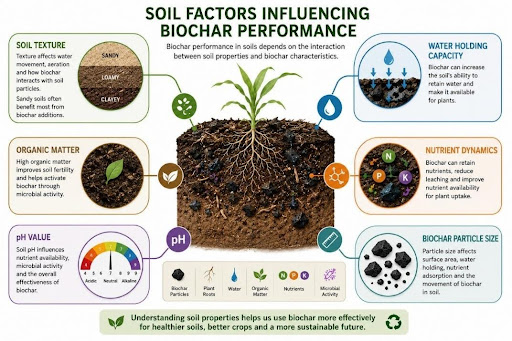
Graphic Exploration Activity
Study the soil profile graphic.
Identify:
- Which factor most strongly influences water retention?
- Which factor affects nutrient availability?
- Which factor influences microbial activity?
Record your observations before continuing.
Biochar may be integrated into agricultural soils through several different pathways depending on farming objectives and local conditions.
One common approach is the incorporation of biochar through compost systems. In this case, biochar becomes biologically activated during composting before being applied to the soil.
Biochar may also be integrated through manure and slurry systems, where it interacts with nutrients before entering agricultural fields. Direct incorporation into soil is another frequently used strategy, particularly in arable farming systems.
Additional integration pathways include substrate mixtures for horticultural production and planting systems for trees and perennial crops.
In many situations, biochar is combined with organic materials before application in order to activate its biological and chemical functionality and improve its interaction with soil processes.
Advantages
Biochar offers several potential advantages when applied as a soil conditioner.
One important benefit is improved soil aggregation, which contributes to better soil structure and enhanced root development. Biochar may also increase water retention, allowing soils to store moisture more effectively during dry periods.
Nutrient buffering is another important function. Biochar can help reduce nutrient losses and improve nutrient availability within the root zone. Its porous structure also creates favourable habitat conditions for microorganisms, supporting biological activity and nutrient cycling.
In addition, biochar may reduce nutrient leaching and contribute to long-term carbon stabilisation. Together, these effects can support more resilient agricultural systems under changing climatic conditions.
Case Study
Sandy Soils Under Drought Stress
A farm located on light sandy soils experiences increasing drought stress and declining yields during dry summers.
The farmer introduces biochar into one field while maintaining conventional management on another.
After several seasons, observations include improved soil moisture retention, stronger root development and more stable crop growth during periods of low rainfall.
This example demonstrates how biochar may contribute to improved soil resilience under challenging environmental conditions.
Limitations
Although biochar offers considerable potential, several limitations must also be considered.
The quality of biochar can vary significantly depending on feedstock origin and production conditions. Different soil types may respond differently to biochar applications, making site-specific evaluation important.
Many effects develop gradually over time, meaning that benefits may not become immediately visible after application. Operational costs and application logistics must also be considered when evaluating biochar systems.
Most importantly, biochar cannot compensate for poor soil management. Instead, it functions as a tool that reinforces good agricultural practices and supports long-term soil improvement strategies.
Reflection
Why might biochar produce different results in sandy soils compared to clay-rich soils?
Discuss your answer with other learners.
Experiences from Practice
Field experiences and pilot projects have reported several positive effects associated with biochar applications in agricultural soils.
Many users observe more stable soil moisture conditions and improved workability of soils. Enhanced root development and reduced drought stress are frequently reported, particularly in regions experiencing water limitations.
Long-term observations often indicate gradual improvements in soil structure and increased resilience of agricultural systems. However, many of these benefits become visible only over several years, highlighting the long-term nature of biochar-based soil development.
Perspectives
Connecting Soil Management and Carbon Farming
The integration of biochar into soils creates opportunities for the development of regional carbon farming approaches and Circular Carbon Economy strategies.
By stabilising carbon within agricultural soils, biochar contributes to long-term carbon retention while supporting soil productivity and resilience. At the same time, it creates opportunities for utilising regional biomass streams and transforming agricultural residues into valuable resources.
Agricultural soils therefore become more than production areas. They become active components of regional carbon management systems that contribute to climate mitigation, resource efficiency and sustainable agricultural development.
Final Key Takeaway
Biochar is a multifunctional soil conditioner that can support soil structure, water retention, nutrient management and carbon sequestration. Its effectiveness depends on local conditions and good agricultural management, making it a valuable tool for building resilient and sustainable farming systems.
Soil Assessment Exercise
Visit an agricultural field, training farm or demonstration site.
Assess:
- Soil texture
- Root development
- Soil structure
- Moisture conditions
- Organic matter content
Prepare a short report describing:
- The main soil challenges.
- Potential benefits of biochar.
- Possible limitations of implementation.
MODULE 4 — APPLICATION FIELD 3: SLURRY TREATMENT
Livestock farming generates large quantities of manure and slurry that play a central role in agricultural nutrient cycles. These materials contain valuable nutrients and organic matter that can support crop production and soil fertility. However, slurry and manure systems are also associated with nutrient losses, greenhouse gas emissions, ammonia volatilisation and odour formation.
Traditionally, manure management has often focused on storage, transport and field application. Today, increasing attention is being given to approaches that improve nutrient retention, reduce emissions and strengthen circular resource management.
Within the Circular Carbon Economy, manure should not be viewed merely as a waste product requiring disposal. Instead, it represents a valuable carrier of nutrients, organic matter and carbon that can potentially be stabilised and integrated into circular agricultural systems.
Biochar creates opportunities to connect animal husbandry, nutrient management and soil improvement within one integrated material flow. By interacting with nutrients, moisture and organic compounds, biochar may improve the efficiency of slurry systems while contributing to long-term carbon retention.
Learning Outcomes
After completing this learning unit, learners will be able to explain how biochar can be integrated into slurry and manure systems, identify the main factors influencing its effectiveness, evaluate the potential benefits and limitations of biochar applications in livestock farming and assess how biochar contributes to circular nutrient management and climate-smart agriculture.
Did You Know?
A significant proportion of nitrogen losses in livestock systems can occur during manure storage and handling. Reducing these losses not only benefits the environment but also helps retain valuable nutrients that can later be used for crop production.
- Unit 1: Why Use Biochar in Slurry Systems?
- Unit 2: Understanding Slurry & Manure Systems
- Unit 3: How to Integrate Biochar into Slurry Systems
- Unit 4: Advantages & Limitations
- Unit 5: Experiences & Perspectives
The use of biochar within slurry and manure systems can contribute to several important improvements in nutrient management and environmental performance.
One of the most frequently discussed benefits is the potential reduction of ammonia emissions. Ammonia losses represent both an environmental challenge and a loss of valuable nitrogen resources. Biochar may help retain nutrients within manure systems and reduce volatilisation losses during storage.
Biochar may also contribute to reducing odours associated with livestock manure. Through its porous structure and adsorption properties, biochar can interact with volatile compounds that contribute to unpleasant smells.
In addition, biochar may support more efficient nutrient cycling by stabilising nutrients before they are returned to agricultural soils. This creates opportunities for improving nutrient use efficiency and strengthening the connection between livestock production and crop production.
At the same time, biochar introduces stable carbon into manure management systems, creating a pathway for long-term carbon transfer into agricultural soils.
Quick Fact
Every kilogram of nitrogen retained within a slurry system represents nutrients that remain available for crop production rather than being lost to the environment.
Reflection
Think about livestock systems in your region.
What are the main challenges associated with manure management?
- Nutrient losses
- Ammonia emissions
- Odour formation
- Storage capacity
- Environmental regulations
Discuss which of these challenges could potentially be addressed through improved nutrient management strategies.
Technical Properties
The effectiveness of biochar in slurry systems depends on the interaction between biochar characteristics and manure properties.
Several important parameters influence system performance. Slurry composition determines the concentrations of nutrients, organic matter and moisture present within the system. Dry matter content affects handling characteristics and nutrient distribution, while nutrient concentrations influence the overall fertiliser value of the manure.
The pH value is particularly important because it affects nutrient stability and ammonia volatilisation. Storage conditions such as temperature, aeration and storage duration also influence nutrient losses and biological processes.
Finally, the adsorption properties of biochar determine how effectively nutrients, moisture and organic compounds can be retained within the system.
The interaction between slurry properties and biochar quality strongly influences the effectiveness of the application.
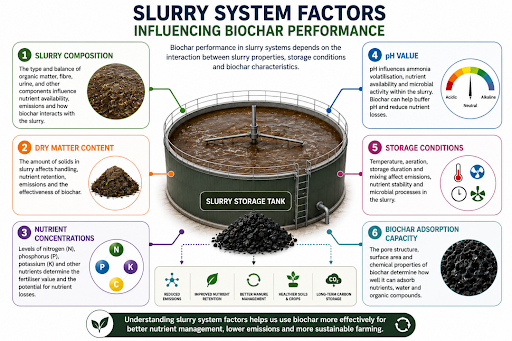
Graphic Exploration Activity
Study the slurry system graphic.
Identify:
- Which factor most strongly influences nutrient availability?
- Which factor affects ammonia emissions?
- Which factor determines the nutrient retention capacity of biochar?
Record your observations before continuing.
Biochar may be integrated into slurry and manure systems at several different points within the livestock production chain.
One common integration pathway is through stable bedding systems. In this approach, biochar is added to bedding materials where it interacts with manure, moisture and organic compounds before entering storage systems.
Another approach involves the direct addition of biochar to manure storage facilities or slurry pits. During storage, biochar can absorb nutrients, moisture and organic compounds, becoming biologically and chemically activated.
Biochar may also be incorporated during pre-application treatment, where it is mixed with slurry before field application. This can improve nutrient retention and support more efficient nutrient recycling.
The most effective integration strategy depends on livestock species, manure type, farm management systems and operational objectives.
Advantages
The integration of biochar into slurry systems may create several advantages for both livestock production and crop farming.
One important benefit is the reduction of ammonia losses, helping to retain valuable nitrogen within the system. Reduced odour emissions may also improve working conditions and reduce environmental impacts associated with livestock production.
Biochar may support improved nutrient retention, allowing a greater proportion of nutrients to remain available for agricultural use. Some users also report improved slurry homogenisation and more stable manure management systems.
An additional advantage is the strengthening of connections between livestock and crop production. By retaining nutrients and carbon within the agricultural cycle, slurry-biochar systems support more integrated and circular farming approaches.
Case Study
Dairy Farm Nutrient Management
A dairy farm experiences increasing challenges associated with ammonia emissions and nutrient losses from slurry storage.
The farmer begins integrating biochar into the slurry management system and monitors changes over several production cycles.
Observations include reduced odour intensity, improved slurry consistency and increased confidence that nutrients are being retained within the system before field application.
While results vary depending on management conditions, the case illustrates how biochar may support improved nutrient management within livestock production systems.
Limitations
Although biochar offers considerable potential within slurry systems, several limitations must be considered.
Additional labour may be required to handle, mix and monitor biochar applications. Operational costs associated with purchasing or producing biochar must also be evaluated.
Dust formation during handling may require additional precautions, particularly in enclosed livestock environments. Furthermore, the effectiveness of biochar can vary depending on manure type, storage conditions and management practices.
Successful implementation often requires technical adaptation of existing systems as well as a good understanding of nutrient management processes.
For these reasons, biochar should be viewed as a management tool that supports system improvement rather than a universal solution for all manure-related challenges.
Reflection
Why might biochar perform differently in cattle slurry compared to pig slurry?
Discuss the potential influence of manure composition and management systems.
Experiences from Practice
Practical experiences from farms, pilot projects and demonstration systems indicate several potential benefits associated with biochar integration into manure management.
Many users report reduced odour intensity and more stable slurry systems. Improved nutrient management and enhanced confidence in nutrient retention are also frequently mentioned.
Some livestock producers observe improved conditions within animal housing systems, particularly when biochar is integrated into bedding materials.
Long-term experiences further suggest that soils receiving slurry-biochar mixtures may benefit from improved nutrient availability and increased carbon inputs, strengthening the connection between livestock systems and soil improvement strategies.
As with all agricultural innovations, results vary depending on farm conditions, management practices and environmental factors.
Perspectives
Connecting Livestock Production and Circular Agriculture
Biochar-slurry systems create important opportunities for the development of circular nutrient management strategies.
By reducing nutrient losses and retaining valuable resources within agricultural systems, these approaches contribute to more efficient use of nutrients and organic matter. They also create opportunities for reducing emissions and supporting climate-smart agriculture.
The integration of biochar into manure systems strengthens the link between livestock production and crop production, allowing nutrients and carbon to circulate more effectively within farming systems.
At a broader level, biochar-slurry systems support carbon farming approaches, regional bioeconomies and long-term soil carbon retention strategies.
Instead of viewing manure as a waste product, these systems encourage a resource-oriented perspective in which nutrients and carbon are continuously recycled and reused.
Final Key Takeaway
Biochar can help transform manure management from a waste-handling process into a resource management strategy. By supporting nutrient retention, reducing emissions and strengthening links between livestock and crop production, biochar contributes to more circular, resilient and climate-smart agricultural systems.
Slurry System Assessment
Visit a livestock farm, training centre or demonstration facility.
Assess:
- Manure management practices
- Storage systems
- Nutrient management challenges
- Potential emission sources
- Opportunities for nutrient retention
Prepare a short report describing:
- Current management practices.
- Potential integration points for biochar.
- Expected benefits and limitations.